
I ran cross country in high school, along with the mile and the 800 on the track side. Nothing that made anybody’s highlight reel — just miles of pushing through the kind of pain that teaches you patience, and two distances that demand you know exactly how much of yourself to spend and exactly when to spend it. Go out too hot in the 800 and you’re paying for it the whole back half. Hold back too long in the mile and the race is over before you ever got to run it. But once you’ve stood on a line — whether it’s a muddy course cutting through the woods or a chalk stripe on a track — and felt that gun go off in your chest before it even fires, you never watch a race the same way again. You watch it in your legs. So when I got the chance to sit trackside at Hayward Field for Day 2 of the Prefontaine Classic on July 4th, camera up, I wasn’t just there as a photographer. I was there as somebody who still remembers what that clock sounds like when it’s chasing you.
Let’s talk about the kid in lane three. You hear the crowd shift before you see why. That’s the first thing that changes when you’re not watching on a screen — you feel the stadium lean forward as one body. That’s what happened before Tate Taylor’s 200m even started. Eighteen years old, still in high school, lined up against Olympic champion Letsile Tebogo and a field of grown men who’ve been cashing appearance checks on this circuit for years.
I had my lens on lane three coming off the curve, and I’m telling you, from where I sat you could see the exact stride where the race stopped being close. Taylor ran a personal-best 19.75 into a headwind — third-fastest by a teenager in history, faster than Usain Bolt ever ran at that age. I got the frame of him crossing the line, arms already starting to rise, Tebogo still fighting a half-step back. That photo is going to mean something in ten years. I could feel it through the viewfinder.
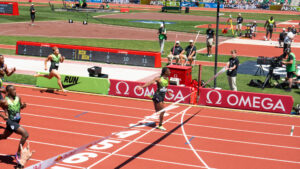
The women’s mile might’ve been the loudest that place got all day. Nikki Hiltz against Faith Kipyegon — a three-time Olympic gold medalist, the world record holder, a woman nobody had beaten in a mile or 1500m in five years. From the rail you could see Kipyegon’s shadow the whole final lap, right on Hiltz’s shoulder like it had been surgically attached.
Then, with about eighty meters left, Hiltz found something. I caught three frames of that last kick — the one where she pulls level, the one where she pulls ahead, and the one where she’s already looking at the clock instead of her competition. 4:17.49. Thirteen hundredths ahead of Kenya’s Dorcus Ewoi, thirty-one hundredths clear of Kipyegon. My hands were shaking a little getting that last shot in focus. I ran that same distance back in the day, and I know exactly what it costs to find another gear when your body’s already told you there isn’t one.
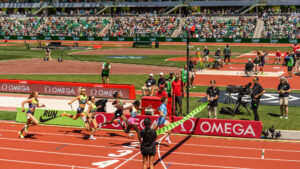
Melissa Jefferson-Wooden and Sha’Carri Richardson in the women’s 100m was the kind of race where you don’t actually know who won until you check the frame. 10.78 to 10.79. I had four cameras going and I still needed the official photo to confirm what my own eyes told me a half-second too late. That’s the margin these people live in — a hundredth of a second, the width of a shoelace.
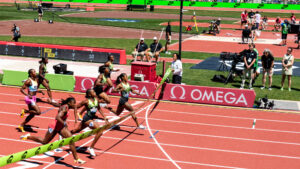
Kayinsola Ajayi’s upset of world champion Oblique Seville in the men’s 100m had that same electricity, and Masai Russell’s meet-record run in the 100m hurdles — holding off world record holder Tobi Amusan — happened so fast off the rail that I almost missed my focus pull entirely. Jamal Britt broke a meet record of his own in the 110m hurdles. Lilian Odira ran down Olympic champion Keely Hodgkinson in the 800m, same finish as last September’s World Championships, like she’s got Hodgkinson’s number saved.
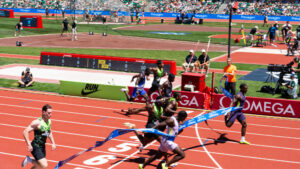
Between the mile and the men’s 100m, I ended up next to Dawn Staley for a few minutes — she was out enjoying the meet like the rest of us, and it turned into one of those brief, easy conversations you don’t plan for. It stuck with me for the rest of the day, honestly — watching Tara Davis-Woodhall come back from what she called a rough week to win the long jump, watching Cameron Myers grind out the Bowerman Mile, watching Faith Cherotich put the steeplechase field away like it was personal. Every one of them building toward a moment like the one Coach Staley and I were just talking about.
Running track teaches you something photography only confirms later: the story isn’t in the middle of the race. It’s in the last ten meters, when everybody’s out of tricks and all that’s left is who they actually are. That’s the frame I’m always hunting for, whether I’m at Hayward Field with a 400mm lens or in an edit bay trying to find the right beat for Xerxes Hughes to finally stop running from himself.
The Prefontaine Classic gave me a reminder of why I fell in love with this sport before I ever picked up a camera. Some things you don’t forget how to feel, even years removed from the blocks. You just find new ways to capture them.